Study reading
Semaglutide evidence: what does a reported percentage count?
A documentary reading of denominators, overlapping categories and the meaning of a treatment endpoint.
Define what the number counts
Post hoc pooling.[1]
An informative percentage answers a counting question before it answers an evaluative one. What enters the numerator? What collection supplies the denominator? What rule places an observation into a category? Without those three definitions, a small number can sound reassuring while leaving its meaning unresolved. A percentage of people who reported something and a percentage of reports describing that thing can share the same digits yet answer different questions. The unit belongs in the claim itself.
Consider a fictional review that says, 'Few problems were reported.' That sentence leaves open whether few people reported anything, whether few reports met a particular definition, or whether reports were few relative to opportunities to report. These are different propositions. Writing the intended fraction in words exposes the ambiguity: people meeting a condition divided by eligible people is a different object from qualifying reports divided by all reports. Neither denominator can silently replace the other.
In this hypothetical review, even defining 'problem' would not finish the job. The counting rule must specify how repeated reports from one person contribute. A person might enter a participant numerator once while contributing several records to an event numerator. Combining observations also requires a rule for their relative influence. A pooled summary is therefore a result of defined operations, not simply a larger collection of interchangeable numbers. Interpreting its size comes after identifying those operations.
Repeated reports change the weighting
Events received severity classifications.[1]
Take an explicitly fictional group of ten people. Nine people each make one mild report; the remaining person makes nine severe reports. This invented ledger contains eighteen reports: nine mild and nine severe. Half the reports are mild, yet nine of the ten people have only mild reports. Both calculations are correct because they divide different numerators by different denominators. These are demonstration numbers, not observations from the paper. Their purpose is to show how repeated contributions alter a summary.
In the fictional event calculation, every report receives equal weight. That gives the person with repeated reports as much influence as everyone else combined. In the fictional participant calculation, each person contributes once. Moving between these summaries changes the weighting, even though the underlying ledger stays fixed. An event majority, if one occurred, would not automatically establish a participant majority. Nor would a participant majority reveal how concentrated the total reporting burden was among the remaining people.
A statement such as 'the reports were mostly mild' consequently needs its own counting definition. It cannot be rewritten as 'most people experienced only mild problems' without another calculation. A participant classification might use the most severe report, any qualifying report, or a specified reporting occasion; those rules create different questions. The fictional ledger illustrates why the rule must be named rather than guessed. Describing one unit faithfully is more useful than giving an apparently comprehensive answer assembled from incompatible units.
Overlapping categories do not form a total
Now consider a separate, explicitly hypothetical group of forty people. Twelve report category A, nine report category B, and five report both. Adding the category totals counts the overlap twice. Subtracting that duplicate contribution gives twelve plus nine minus five, or sixteen people with either category. The remaining twenty-four report neither category. In this invented example, 'neither' concerns only the two categories defined for the exercise; it says nothing about other possible categories.
Suppose the overlap were missing from this hypothetical ledger while the two category totals remained known. The combined total could be as small as twelve if everyone in the smaller category also belonged to the larger one. It could be as large as twenty-one if the categories did not overlap. Every intermediate overlap would give an intermediate union. Thus the hypothetical total with either category lies between twelve and twenty-one. Choosing a single total without overlap information would add an assumption.
The subtraction works because both categories refer to the same hypothetical people under the same inclusion rule. If one percentage instead used only people answering a follow-up question, the denominators would no longer align. A shared percent sign would not repair that mismatch. Likewise, 'both categories' and 'either category' are distinct endpoints: the first requires joint membership, while the second accepts membership in either set. A review can change its apparent conclusion merely by replacing one word with the other, without changing any individual record.
Read the endpoint before the bars
A bar's height becomes interpretable only after its endpoint is fixed. Let D represent the particular event defined in the caption. A proportion for D describes membership in that set under the stated conditions. It does not automatically describe every event a reader might regard as undesirable. Treating the caption as part of the measurement prevents a narrow answer from expanding into a much broader promise when someone summarizes the picture in a sentence.
For a separate hypothetical study, define T as stopping treatment for any reason and O as ending observation. A specifically attributed treatment stop can belong within T, but a count for T also includes other stated reasons. O raises a different question: a person could stop treatment while observations continue, or end observation without a recorded treatment stop. These are logical possibilities in the hypothetical design, not assertions about particular records here. Distinguishing the sets prevents 'stopped treatment' and 'left the study' from becoming interchangeable.
The complement of D has an equally narrow meaning: the defined event was not counted for those members of the denominator. Renaming that complement 'no symptoms' would require a different set definition and evidence connecting the two. Absence of one endpoint cannot establish absence of every experience that might precede it. A faithful interpretation therefore retains the endpoint's conditions when moving from chart to prose. The comparison remains informative without being stretched into a complete account of tolerability.
Read the endpoint before the bars
Scroll within the figure for its full width. Focus this region and use the left and right arrow keys.
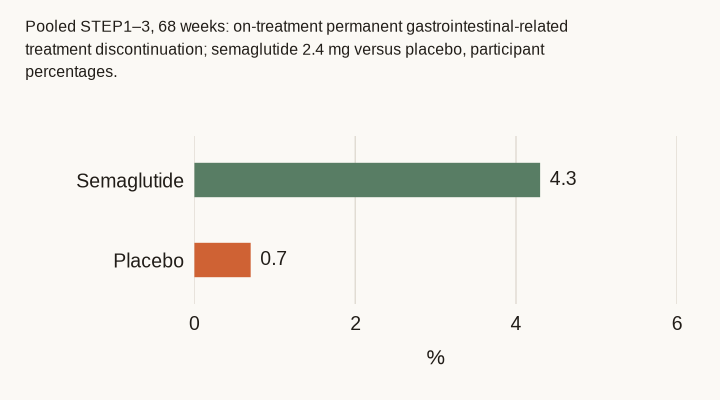
Read the figure as a table
| Arm | % |
|---|---|
| Semaglutide | 4.3 |
| Placebo | 0.7 |
A reason code is part of the measurement
Imagine a fictional withdrawal form with one box for a primary reason and optional boxes for secondary reasons. One person records reason A as primary and reason B as secondary. Under a rule that counts only primary reasons, the person enters category A. Under a rule that counts every listed reason, that same person enters both A and B. The recorded experience has not changed; the summary changes because the coding instruction changes.
These hypothetical rules also affect whether categories can be added. A single primary-reason field creates mutually exclusive coded categories if every form has exactly one completed primary field. Allowing multiple reasons removes that property. Neither design is automatically preferable for every question. One summarizes the selected primary explanation; the other preserves the presence of additional explanations. A percentage generated under one rule cannot answer the other's question unless the original records permit a separate calculation.
Recorded attribution is also distinct from a demonstrated mechanism. In the fictional form, selecting reason A tells us how a decision was documented. It does not establish what would have happened if A had been absent while everything else stayed unchanged. That counterfactual is not written into a checkbox. Consistent coding can improve the clarity of a descriptive count without turning it into causal proof. This distinction allows an attributed endpoint to remain useful while keeping its interpretation tied to the evidence it actually contains.
Rounded rates do not recover a participant ledger
For a purely hypothetical rate displayed as 7.4%, specify ordinary nearest-tenth half-up rounding. Under that rule, an underlying percentage from 7.35% inclusive to below 7.45% would display as 7.4%. The lower boundary rounds upward into the displayed value; the upper boundary rounds upward out of it. Another tie rule could change boundary inclusion. These invented decimals demonstrate rounding, not the precision of a trial result or a range of plausible patient outcomes.
The hypothetical rounding interval is not a confidence interval. It describes values compatible with a formatting rule, not uncertainty caused by sampling or estimation. For a simple count percentage, a known denominator and rounding rule can narrow the possible integer numerators; a unique integer may be recoverable even without the unrounded percentage, while several compatible integers would leave ambiguity. An adjusted percentage is a different mathematical object. Its weighting or modeling operations need not preserve the direct relationship between a displayed decimal and a recoverable whole-person count.
The same caution applies to visual precision. Closely spaced tick marks or a long decimal expansion do not supply an uncertainty estimate. A chart showing point values alone cannot establish a significance test, a confidence interval, or how an estimate would vary across repeated samples. In the hypothetical rounding exercise, narrowing the display format would change what is printed without collecting another observation. Distinguishing formatting precision from evidential precision keeps a clean-looking figure from acquiring information that it does not show.
A common label does not guarantee comparable measurement
Consider two fictional review documents that both use the heading 'reported problems.' The first asks everyone a broad question; the second presents a list of named categories. Even with an identical heading, the reporting prompts are different parts of the measurement process. A comparison would need to address whether those prompts capture the same target. The hypothetical difference does not establish which document will report a higher percentage; it identifies a reason the quantities may not be interchangeable.
Add a second hypothetical difference: one document assigns a single primary reason, while the other counts any listed reason. This changes the classification rule after information is collected. Matching the prompts would leave that coding difference unresolved, just as matching the coding rule would leave the prompt difference unresolved. The two stages are distinct. A comparison becomes clearer by tracing how an observation enters the record and then how the record enters the numerator.
Matching definitions would make the hypothetical percentages more directly interpretable as answers to the same descriptive question. It would not, by itself, show that populations were comparable or that any contrast resulted from a treatment rather than another difference. Measurement alignment is necessary for some interpretations but does not supply every condition they require. For another grouping question, the companion analysis develops a different grouping question. The useful connection is how a definition shapes a comparison, rather than which displayed number looks more favorable.
A recommendation defines a different question
Severe gastroparesis falls outside Wegovy's recommended use.[2]
A population summary and an applicability statement have different logical forms. One describes an aggregate under a defined set of observations. The other addresses the domain within which a conclusion or recommendation applies. A favorable average cannot establish that every possible condition belongs inside that domain. Reading the two kinds of statement separately prevents an empirical summary from silently taking on the authority of a recommendation about a particular person.
Imagine a hypothetical evidence table with columns for the measured outcome, the population definition, and the applicability question. The outcome cell contains a favorable average, but the applicability cell is empty. Copying the average into that empty cell would not answer the missing question; it would change the column's meaning. Even a very precise estimate of the measured outcome would leave that logical gap intact. Precision strengthens an answer to its own question, not to every neighboring question.
The fictional table needs information relevant to applicability, not simply another favorable outcome entry. Nor can a review resolve the gap by treating absence of an answer as an affirmative answer. As a separate reference, the compound profile presents separately dated medical fields for a different reading purpose. Keeping those fields distinguishable from a study interpretation helps readers see which kind of statement they are considering. The task here is to recognize the boundary of a claim, not make an individual treatment decision.
An exclusion is not a score adjustment
A prior serious hypersensitivity reaction to semaglutide or any Wegovy excipient contraindicates Wegovy.[2]
A categorical restriction cannot be interpreted as a small unfavorable contribution to an otherwise positive average. The relevant logic concerns whether a proposed inference is within its domain before its supporting evidence is weighed. Adding more observations about a different question does not remove a restriction on the question at hand. This is why the structure of an argument matters alongside the amount of evidence gathered for it.
Imagine a fictional scoring system that combines clarity, convenience, and an outcome measure into one overall score. Before any weighting, the system must specify which cases it is designed to evaluate. If a case is outside that domain, extra points for convenience cannot bring it inside. Doing so would confuse a rule about eligibility with a preference among eligible cases. The fictional example illustrates a logical error in aggregation; it does not supply a treatment score or a rule for individual care.
A review should therefore keep a restriction visible as a distinct statement rather than bury it among favorable descriptors. A reader can inspect whether the conclusion respects that statement without assigning it a numerical penalty. For further reading, the existing side-effect guide is an additional reading destination, not a substitute for the exact question considered here. The interpretive distinction remains the same: evidence that supports an average outcome and information that bounds a recommendation perform different jobs in an argument.
Keep the evidence attached to its original question
A source can be scrutinized without declaring its conclusion false.
Transparent provenance allows a reader to ask how an analysis was produced and whether its stated operations can be examined. Reproducibility asks a related but different question: would the same inputs and rules yield the same output? Neither question is answered by liking or disliking a source. An arithmetic result may be reproducible while its interpretation reaches beyond the population or endpoint that generated it. Scrutiny needs to address both the calculation and the claim built around it.
Imagine a fictional service that copies a published percentage into a sentence about its own customers. The digits remain unchanged, but the population has been substituted. To justify that move, the service would need an argument connecting the original population, intervention, measurement rules, and setting to its new claim. Merely sharing a product name would not establish those connections. Nor would accurately reproducing the original percentage demonstrate that the service's customers experienced the same result.
The hypothetical substitution is a transportability problem: what supports moving an inference from one defined setting to another? If the bridge is absent, the original result can remain informative about its own question while the new claim remains unsupported. For a broader editorial context, our review methodology provides context for reading documentary claims. The central analytical task is to locate where a conclusion changes its subject, then identify what evidence would justify that change. Source transparency makes this inspection possible; it does not predetermine its verdict.
Editorial assessment
The strongest interpretation is the one that preserves the question through every step of the argument. A defined unit becomes a numerator, a denominator supplies its reference population, and a classification rule determines membership. Rounding, weighting, and aggregation then shape the reported quantity. None of those operations permits the final sentence to change its subject without explanation. This is a positive standard for informative evidence, not a demand that one analysis answer every question. Additional evidence can strengthen a claim when it addresses the specific gap: overlapping records can resolve a union, aligned definitions can clarify a comparison, and an explicit applicability argument can support a proposed extension. More evidence about an unrelated outcome cannot substitute for that missing connection. For a commercial claim or an individual inference, the necessary bridge must be stated and supported on its own terms. Preserving these distinctions lets a reader recognize a useful narrow result while declining an unsupported expansion.
Questions and answers
Can symptom percentages be added?
Only when the counting rules justify the addition. Categories measured in the same people may overlap, so their sum can count some people twice. The fictional set exercise subtracts that overlap to obtain a union. Without overlap information, a range may be supportable where an exact total is not. Different denominators require another reconciliation before even that calculation is meaningful.
Does a stopping percentage measure every problem?
No. It counts the particular stopping endpoint as defined. Its complement means that endpoint was not counted; it cannot automatically be relabeled as freedom from every symptom or difficulty. A broader claim would need observations and definitions that actually address the broader question. Keeping the endpoint narrow preserves the usefulness of the result without implying comprehensive reassurance.
Can a service inherit a published trial result?
Repeating a published value does not establish that it describes a service's customers. The fictional transfer example changes the population while preserving the digits. A defensible extension needs evidence connecting the original setting and measurement to the new claim, including relevant differences. Accurate quotation is one requirement for documentary integrity; it is not itself a validation of that extension.
Limits of this reading
This article examines the logic of documentary interpretation and uses explicitly fictional exercises. It does not reconstruct participant records, estimate uncertainty from chart heights, or evaluate an individual treatment decision. The displayed figure and linked medical fields have their own stated scope. No provider outcome or personal result is inferred from them.