Study reading
Tirzepatide evidence: what can a subgroup comparison establish?
An analysis of group membership, conditional averages and the assumptions behind a causal interpretation.
Read the membership rule first
One event sufficed.[1]
To see what a membership rule preserves, imagine two fictional records. One contains a single qualifying report; the other contains several. A binary rule can map both records to yes. That shared label does not make their histories interchangeable. It answers whether each record crossed a specified threshold, while leaving the sequence beyond that threshold unresolved.
In this hypothetical exercise, replacing the original records with their labels is a deliberate loss of information. You can recover the label from either complete record, but you cannot reconstruct either complete record from the label. Many different histories fit the same answer. A comparison based on that answer therefore cannot, by itself, distinguish those histories.
The named symptom set in the chart gives the reader a starting point for defining the question. A useful logical test is to ask what would change a classification and what could change without changing it. In the invented example, another qualifying report leaves yes unchanged. Its timing or intensity could also differ without the label communicating that difference.
The complementary category needs equally careful reading. Negating a narrowly defined proposition does not establish every broader negative proposition. If a hypothetical form asks whether a specified event was recorded, no answers that question; it does not become a complete description of the person. Begin interpretation with the scope of the classification, before attaching a story to either group.
Assignment and later grouping are different operations
Assignment does not settle every later comparison.
Consider a hypothetical experiment that assigns people to treatments by chance, then sorts them according to an observation made afterward. These are two separate operations. The first determines treatment assignment. The second uses a person's subsequent record. Knowing how the first operation works does not tell us which characteristics will be shared by people entering each later group.
In this imagined experiment, suppose a background characteristic helps determine the later observation. Sorting on that observation can then change the distribution of the characteristic across the resulting groups. No failure of the original random procedure is required. The later sorting rule, rather than the initial assignment rule, explains why a new comparison needs its own justification.
This distinction can be tested by specifying the comparison before choosing a statistical procedure. A contrast between assigned treatments asks one question. A contrast between people selected by a subsequent observation asks another. Retaining the treatment name in both descriptions does not make the questions identical. Nor does a larger sample restore an assignment mechanism that was never used for the later classification.
For the hypothetical experiment, an informative analysis would document the sorting rule and identify characteristics that could influence both sorting and outcome. Whether those characteristics actually differ would require evidence, not an assumption in either direction. The logical lesson is limited but useful: a design guarantee belongs to the comparison it creates, and must be justified again when the comparison changes.
Composition can move an average
Here is a fully invented numerical example, with abstract outcome units and no biological interpretation. Type A has outcome 10 and type B has outcome 4. A group containing three A records and one B record averages 8.5: the total is 34 across four records. Another group containing one A record and three B records averages 5.5: the total is 22 across four records.
Within each type, the hypothetical outcome is identical in the two groups. The overall difference comes entirely from the proportions of the types. Comparing the averages without inspecting composition would conceal this construction. It could invite an explanation involving group membership even though the example assigns no outcome change to membership itself.
Now imagine giving the two types equal weight in both fictional groups. The standardized averages would then be equal, because they would combine the unchanged type-specific outcomes in the same proportions. This does not uncover a hidden clinical effect. It replaces the original composition question with a common composition question. The calculation is useful because it makes the changed weighting explicit.
Standardization also requires a choice about whose composition matters. Equal weights are convenient in this invented exercise, but convenience alone would not justify them for a real target population. The analyst would need to explain the intended population and the information supporting its weights. Two mathematically correct averages can answer different questions when they distribute attention differently across the same underlying types.
Read the model estimate on its own terms
Read the displayed estimate as an answer to the question defined by its caption, then ask what a different question would require. A model produces a summary through specified mathematical relationships. Calling that summary a mean does not make every possible mean equivalent to it. The choice of variables, target conditions and weighting determines what the fitted summary represents.
For a hypothetical illustration, imagine fitting a straight line to an outcome and an abstract background variable. Evaluating that line at a common background value is different from simply averaging all observed outcomes in each group. Both computations may be reproducible. They summarize different constructions, so the analyst must say which construction supports the sentence being written.
A counterfactual question goes further still. It asks what would happen to the same target people under a specified change, compared with what would happen without that change. Merely changing a group label in a fitted equation does not establish that the corresponding real intervention has been defined or that its outcome is identified. A mathematical substitution and an intervention are different operations.
The horizontal lengths and labelled values organize a comparison visually. They cannot supply an inferential argument that the analysis has not supplied. To assess a claim of a reliable difference, a reader would need an appropriate uncertainty analysis for the precise contrast. To assess causation, the reader would additionally need a design and assumptions connecting that contrast to a well-defined intervention.
Read the estimate on its own terms
Scroll within the figure for its full width. Focus this region and use the left and right arrow keys.
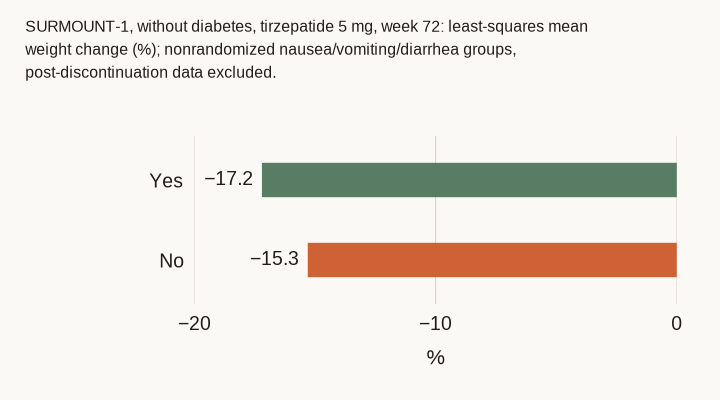
Read the figure as a table
| Reported | % change |
|---|---|
| Yes | −17.2 |
| No | −15.3 |
Selection can connect otherwise separate causes
Imagine a hypothetical diagram with three abstract variables. X influences entry into a later group. U also influences entry into that group, and U influences the outcome. Initially, X and U are independent in this invented population. The group is a common consequence of X and U. Restricting attention to that consequence can connect causes that were initially separate.
A simple fictional entry rule makes the logic concrete: a record enters if either X or U is present. Among selected records where X is absent, U must be present. Among selected records where X is present, U need not be present. Thus, knowing X becomes informative about U within the selected set, even though it was uninformative in the original population.
Because U also affects the outcome in this hypothetical diagram, the association created by selection can extend to the outcome. Following the path explains the problem: selection links X with U, and U links onward to the outcome. The path does not represent an effect traveling from X to the outcome. It represents information created by the restriction.
This example is a possible structure, not a proposed account of what happened in the study. It shows why an adjustment choice needs a causal rationale. Automatically controlling every available variable can be inappropriate when a variable is a common consequence. A defensible analysis would explain the timing and role of each proposed adjustment, then examine whether the required relationships are supported.
An omitted record is not a zero
The chart's stated data boundary raises a question about which outcome is being summarized. To examine that question without inventing study data, consider four fictional people. Two observed outcomes are 6 and 10, giving an observed mean of 8. The other two outcomes are unknown. Nothing in that observed mean specifies the missing values.
In one explicitly hypothetical completion, the missing outcomes are 2 and 2. The full total becomes 20 and the four-person mean becomes 5. In another hypothetical completion, the missing outcomes are 14 and 14. The full total becomes 44 and the mean becomes 11. Both completions preserve exactly the same observed records.
These invented scenarios demonstrate nonidentification: the available observations are compatible with different answers to the full-group question. They do not estimate the missing outcomes or predict what any person would have experienced. Treating an unknown as zero would introduce yet another assumption, not remove the problem. Repeating the observed mean more precisely would not distinguish the two completions.
A sensitivity analysis makes such dependence visible by varying an explicit assumption. Its purpose is to show how conclusions change, not to designate an appealing scenario as fact. Additional outcome observations, or justified information constraining their distribution, could narrow the uncertainty. Alternatively, the analyst could deliberately retain a narrower target question. That choice must remain visible when the result is described to readers interested in the full group.
A mediation question needs additional assumptions
Suppose a fictional treatment contrast is represented as a sum of a pathway component and a remainder. Writing that decomposition is easy; interpreting its components causally is harder. The pathway must refer to a specified intermediate variable and a defined way of changing it. Otherwise, different interventions could be hidden behind the same phrase, producing no single counterfactual question.
In this hypothetical construction, the intermediate variable must occur before the outcome it is proposed to influence. Temporal order would rule out some impossible explanations, but it would not settle common causes. If an unmeasured factor influences both the intermediate variable and the outcome, their association could combine the proposed pathway with another relationship.
The imagined remainder also depends on how the decomposition is defined. If changing the intermediate variable has different consequences under different treatment conditions, an analyst must specify which condition anchors the comparison. A single partition of a total is not automatically a universal account of its causes. Transparent definitions make these choices inspectable without pretending that the choices validate themselves.
A small fitted pathway component would not establish that manipulating the intermediate variable is safe or beneficial. That would require an intervention question with its own relevant outcomes and evidence. For a different measurement question, see the companion endpoint analysis; its results are not inputs to this hypothetical decomposition. The essential task is to distinguish an algebraic partition from a justified explanation of how an outcome arose.
Keep recommendation boundaries separate from averages
Zepbound is not recommended for severe gastroparesis.[2]
An applicability assessment has more than one dimension. Imagine a hypothetical evidence matrix with rows for different target populations and columns for the outcome, the circumstances of measurement and the restrictions on interpretation. A summary occupying one cell does not fill all the others. Extending it requires a reason to believe that the change of row or column preserves the relevant relationships.
In this fictional matrix, suppose a result estimates an average for population A, while the proposed claim concerns a member of population B. Even an exact estimate for A would not answer whether the relevant features are shared. Greater precision within A would narrow estimation uncertainty there; it would not by itself resolve the separate uncertainty about transfer to B.
Individual prediction creates another change of question. Two hypothetical populations can have the same average but different spreads, so that the average alone leaves different possibilities for an individual. A complete prediction task would specify the target outcome and conditions and assess how well predictions work for that target. It would not substitute the existence of a group mean for that assessment.
Readers can use the compound profile as a separate place to examine the retained compound information. Keep that documentary task distinct from the hypothetical matrix exercise. The exercise explains why an attractive average cannot serve simultaneously as a full applicability assessment, an individual prediction and a judgment about every condition of use.
A restriction cannot be averaged away
Known serious hypersensitivity to tirzepatide or any Zepbound excipient contraindicates Zepbound.[2]
A restriction and a statement about an average have different logical forms. A restriction defines a boundary on application. An average summarizes a specified collection of outcomes. Combining more observations into the average does not, through arithmetic alone, change the boundary. To revise a restriction would require evidence relevant to its basis, rather than simply a more appealing summary of another question.
Consider a hypothetical claim that every member of a group receives the same benefit. A counterexample would refute that universal claim. It would not necessarily refute a claim about the group's average, because averages permit variation. Conversely, establishing an average would not prove the universal claim. Keeping these propositions separate prevents a result from acquiring a stronger meaning during a comparison.
Cross-document comparison introduces a further problem of matching the objects being discussed. The treatment description, formulation, outcome and target population are part of a question's identity. If these differ, an analyst needs an explicit bridge before treating the results as answers to the same question. Similar terminology does not supply that bridge.
For related reading, the existing comparison explainer provides another destination without implying an endorsement from this analysis. The scientific test for any proposed comparison remains whether its quantities are aligned and whether its assumptions support the intended inference. A ranking would require an argument for the ranking itself.
Preserve the question when the result travels
A reproducible calculation still needs an appropriate question.
Imagine a service advertisement that borrows a conditional estimate and presents it as the service's own expected outcome. This is a fictional example, not a statement about a particular business. The advertisement could reproduce the number perfectly while changing the population, the process that selected the records and the conditions under which the outcome was estimated.
The resulting gap is scientific as well as documentary. A transfer argument would need to explain why those changes preserve the quantity of interest. If the advertisement targets everyone entering the service while the borrowed calculation targets a selected subset, the questions differ. Repeating a citation would identify the borrowed estimate without resolving that mismatch.
Reproducibility is nevertheless valuable. An analyst who exposes definitions, exclusions and calculations makes errors and disagreements easier to locate. Another reader can ask whether a dispute concerns arithmetic, the target population, a selection assumption or the meaning attached to a fitted result. Those are distinguishable disagreements and may require different evidence to resolve.
The editorial framework for examining documentary claims appears in our review methodology. The hypothetical advertisement illustrates why such examination should preserve the original question throughout a chain of interpretation. A stronger conclusion requires a stronger bridge from the evidence to the proposed use. Where that bridge is absent, the useful result is a clearly bounded answer, rather than a broader promise attached to a precisely copied number.
Editorial assessment
The central scientific task is to identify which operation supports which conclusion. Classification compresses records, weighting defines an average, selection determines which comparisons are available, and a causal model adds assumptions about interventions. Each operation can be useful without answering all the questions a reader might bring to it. The hypothetical exercises separate these operations so that the point of disagreement becomes testable. Evidence about missing outcomes could constrain a full-population average; evidence about common causes and timing could strengthen an intervention argument; validation in a target setting could support transfer. These additions address different uncertainties and cannot substitute indiscriminately for one another. A commercial or individual claim needs its own explicit connection to the intended population, conditions and outcome. The most informative conclusion preserves that question, identifies the assumptions on which its answer depends and says what evidence would change the answer.
Questions and answers
Does a group label describe every experience within it?
No. In the hypothetical membership example, distinct records mapped to the same label. That mapping preserved a threshold decision while discarding other differences. Recovering those differences would require the underlying records or a richer summary. The label should therefore be interpreted at the level of detail its definition provides, without treating category membership as a complete personal history.
Can a difference between groups identify a symptom effect?
A difference alone does not specify an intervention or eliminate competing explanations. In the invented selection diagram, conditioning on a common consequence connected otherwise independent causes. A causal interpretation would need assumptions and evidence that distinguish the intended pathway from such alternatives. The example establishes a logical possibility, not an explanation of the study's actual results.
What would make a transferred claim more defensible?
First preserve the question: identify the intended people, outcome and conditions. Then justify each change between the original calculation and the proposed setting, including changes in selection and measurement. Evidence addressing those changes would make the bridge more defensible. A source citation or matching terminology alone cannot turn a conditional estimate into an individual forecast or a service's own outcome.
Limits of this reading
This article develops methodological interpretations and explicitly fictional calculations. The examples do not reconstruct participant records or establish a causal explanation for the displayed comparison. They do not provide individual predictions, treatment advice or evidence about a particular service. A different target question would require its own supporting evidence.